How to Choose Heavy Duty Sliding Drawer Rails?
Choosing Heavy Duty Sliding Drawer Rails is a load-and-fit decision, not just a hardware upgrade. A drawer holding stacked tools behaves differently from one carrying folded linens. Its weight, width, extension, mounting style, and opening frequency all affect performance. Small details matter. A rail that feels smooth when empty may sag or bind under load.
The market context is substantial. Grand View Research estimated the global furniture market at USD 736.79 billion in 2023 and forecast continued growth through 2030. That figure covers furniture broadly, not drawer rails specifically, but it underscores the scale of products that depend on reliable moving hardware. For buyers, practical specifications matter more than broad market trends: check rated capacity per pair, cycle-life testing, extension length, and installation clearance. Confirm how the manufacturer defines its load rating; ratings are not always directly comparable.
Quality expert W. Edwards Deming is often quoted: “In God we trust; all others must bring data.” It is a useful reminder, though he was not a drawer-rail industry specialist. Ask suppliers for documented test results, installation instructions, and warranty terms. Then compare them with your actual drawer dimensions and intended load. One caution: published capacity alone cannot predict real-world life. Poor alignment, loose fasteners, or uneven loading can shorten it quickly. The best choice is the rail whose verified specifications match the drawer—not the one with the biggest number on its label.

Understand the Load Capacity and Duty Rating of Drawer Rails
How to Choose Heavy Duty Sliding Drawer Rails?
Heavy-duty rails are selected by more than the drawer’s weight. Check the rated load for the complete pair, not for one rail. Some specifications describe static capacity; others describe loads during movement. A drawer holding 45 kilograms can feel very different when fully extended and pulled quickly. Leave a margin for contents, uneven loading, and occasional impact. Confirm whether the rating assumes side mounting, a particular rail length, or full extension. Small differences matter.
Duty rating describes how often rails are expected to operate, not just how much they can carry. A workshop drawer opened dozens of times daily needs rails tested for frequent cycling. For occasional household use, that level may be unnecessary. Look for cycle-life information and check that the test conditions resemble your setup. A high load rating alone does not guarantee long service; poor alignment can cause binding and wear. In practice, the exact load inside a drawer is often less predictable than planned.
Tips: Weigh typical contents, then include the drawer itself. Check mounting instructions and keep both rails parallel. If the drawer will be heavily loaded, test it gradually before regular use. Don’t ignore a slight wobble.
Measure the Drawer and Check Available Installation Space
Before selecting heavy duty sliding drawer rails, measure the drawer box, not just its front panel. The front may overhang the box by several millimeters. Use a tape measure to record the box’s outside width, side height, and depth. Check the depth from the back of the drawer to the inside face of the cabinet. A rail that is too long can hit the cabinet back.
Measure carefully. Then measure again. Cabinet openings are not always perfectly square, especially in older furniture. Check the width at the front, middle, and rear, and note the smallest measurement. Compare that space with the rail maker’s required side clearance. Even a small mismatch can cause rubbing or uneven movement. I’ve found that measuring only once is an easy mistake to make.
Look inside the cabinet for hinges, screws, support rails, or a center divider that could block installation. Leave room for the rail hardware and for the drawer to travel fully open. If the cabinet floor or sides are uneven, note that before choosing a mounting position. A simple sketch with the measurements can help, though it may not capture every bump or twist. Use the rail’s installation specifications to confirm the fit before drilling.
Choose a Rail Type and Extension Length for the Application
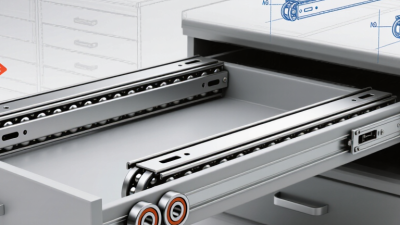
Choosing heavy-duty sliding drawer rails starts with the drawer’s job, not its advertised load rating. Side-mounted ball-bearing rails suit workshop cabinets where visible hardware is acceptable and easy access matters. Under-mounted rails keep drawer sides clear, but require compatible dimensions and careful fitting.
In dusty or damp areas, check the rail’s finish and maintenance guidance; steel alone does not guarantee lasting performance. Even a small mismatch can cause binding.
Next, match extension length to what users need to reach. A three-quarter extension may work for shallow drawers holding frequently used tools. Full extension exposes the back of a deep drawer, which helps with bulky parts or supplies.
Measure cabinet depth, drawer length, and rear clearance before ordering; rails may need space beyond the drawer box. Confirm that the load rating applies to a correctly installed pair. Loads shift during opening, especially when heavy tools sit near the front. A rail can meet its rating and still feel wrong if the drawer is too wide or misaligned.
Tips: Mock up the drawer’s travel before installation. Check handle clearance and screw access. Leave a little tolerance, but remeasure after assembling the cabinet.
Compare Materials, Mounting Styles, and Operating Features
Heavy-duty drawer rails should match the load, cabinet construction, and exposure—not just the advertised capacity. Steel rails suit many workshop and storage drawers; stainless steel is worth considering where moisture may cause corrosion. The World Steel Association’s World Steel in Figures 2024 reports 1,888.2 million tonnes of crude steel production in 2023. That scale indicates broad material availability, not rail quality or rust resistance. Check the rail maker’s rated load and whether it applies to a pair, a specific mounting position, or a tested drawer setup.
Mounting style affects both access and installation. Side-mounted rails are visible and usually straightforward to fit; undermount rails hide beneath the drawer and need accurate clearances. Center-mounted options suit some lighter or narrower drawers, but may offer less lateral stability. Measure the drawer box and cabinet opening carefully. A few millimetres matter. For operating features, compare full extension, soft-close action, disconnect levers, and locking options against the drawer’s real use.
ANSI/BHMA A156.9 provides performance tests for cabinet hardware, including drawer slides; ask suppliers for test documentation, not just a cycle-life claim. One detail is easy to overlook: a smooth empty drawer can bind when loaded. Check movement with the intended weight, and treat any rating without test conditions as incomplete.
Verify Compatibility, Safety, and Maintenance Requirements
Choosing heavy-duty sliding drawer rails starts with the real load, not just the largest number on a product sheet. Check whether the rating applies to a pair of rails and whether it describes a static or moving load. A drawer full of steel tools puts different stress on the rails when extended. Measure the cabinet opening, rail length, side clearance, and mounting points. Confirm that the rail suits the drawer material and travel distance. Small gaps matter.
Safety needs a practical check. The U.S. Consumer Product Safety Commission’s 2023 tip-over report documented 581 furniture- and television-related deaths from 2000 through 2021; 472 involved children. A heavy, fully extended drawer can shift a cabinet’s center of gravity, so anchor tall units and test stability with the drawer open. ANSI/BIFMA X5.5-2021 sets performance tests for desk and table products, but it does not certify every drawer rail. Ask for the rail’s test method and cycle data. Maintenance is easy to overlook: clear dust and metal chips, check screws and alignment, and use only approved lubricant. I would inspect the installation again after a month; a slight sag can appear once the hardware settles.