How to Choose Heavy Duty Telescopic Rail for Your Needs?
Choosing the right Heavy Duty Telescopic Rail can significantly impact your project. These rails are essential for various applications, from industrial machinery to home renovations. Understanding your specific needs is crucial for making an informed decision.
When selecting Heavy Duty Telescopic Rails, consider factors like load capacity, material, and extension length. A robust rail will ensure safety and efficiency. Not all rails are created equal; some may fall short under heavy loads. This can lead to dangerous situations. Experience shows that proper evaluation prevents future issues.
Consulting experts in the field can provide valuable insights. They can guide you toward dependable options that meet your requirements. Don’t rush your choice. Taking time to analyze your needs will lead to better outcomes.
Understanding the Basics of Heavy Duty Telescopic Rails
Choosing the right heavy-duty telescopic rail requires understanding its basic features and capabilities. These rails are designed to support substantial weight, making them ideal for various applications. When selecting one, consider the load capacity, materials, and length options. Each detail matters when determining its suitability for your project.
**Tips:** Pay attention to the weight limit. Exceeding it can lead to failures, which may result in accidents. Always prioritize safety and reliability in your selection.
Different projects may have unique requirements. For instance, the length of the rail should match your specific space constraints. Measure your area accurately to ensure a proper fit. Miscalculations can lead to inefficiencies or even the need for replacements.
**Tips:** Consult with experts if uncertain. Their experience can provide insights that save time and money. Relying on professional advice can prevent common mistakes.
In conclusion, understanding the basics of heavy-duty telescopic rails helps you make informed choices. Be aware of the specifications and their implications on performance. Functionality and compatibility with your needs should guide your decision-making process.
Identifying Your Specific Needs and Requirements
When choosing heavy-duty telescopic rails, understanding your specific needs is crucial. Consider the weight capacity required for your application. Analyze the loads you will be handling and factor in safety margins. For instance, if you plan to use these rails for industrial shelving, choose a model that can accommodate not only the weight of the shelving materials but also additional items as they accumulate.
Next, evaluate the environment where the rails will be installed. Will they face exposure to high humidity or corrosive materials? If so, materials with protective coatings or suitable alloys might be necessary. It's also important to think about the space constraints. A telescopic rail needs enough clearance for smooth operation. Jot these specifics down, as they guide your decision-making.
Lastly, consult with experts if possible. While it may seem daunting, seeking advice from manufacturers or professionals could clarify your choices. They can provide insights into aspects you might overlook. Gathering various opinions can help in identifying common pitfalls. Remember, reflection and research will aid you in selecting the right heavy-duty telescopic rails for your needs.
Evaluating Material and Design Options for Durability
When selecting heavy-duty telescopic rails, material and design significantly impact durability. Steel is often preferred for its strength. Aluminum can be lighter and resistant to corrosion. Each choice has benefits and drawbacks. For heavy loads, steel may be the better option. However, consider the environment. Coastal areas may require more corrosion-resistant materials.
Design features also play a crucial role. Look for rails with a robust locking mechanism. This enhances safety and stability under heavy loads. Adjustable designs offer versatility, accommodating various applications. Ensure the rail's surface is treated to prevent wear over time. A well-designed rail should endure daily rigors while maintaining functionality.
Reflecting on these factors can be helpful. Sometimes, the most durable option isn’t the most expensive one. Assess your specific needs carefully. High-quality construction often comes from meticulous engineering. Don’t overlook smaller details that could lead to larger issues later. Re-evaluating choices after practical use can provide deeper insights into long-term durability.
Choosing Heavy Duty Telescopic Rail: Material and Design Options Analysis
Comparing Load Capacity and Performance Ratings
When selecting heavy-duty telescopic rails,
load capacity and performance ratings play a crucial role.
Key metrics include the maximum load ratings, which often range from 500 to over 1,500 pounds,
depending on the design. Performance ratings indicate how smoothly the rail functions under various weights and conditions.
For instance, some reports suggest that quality rails maintain performance even after 20,000 cycles of use.
This data illustrates their durability in demanding applications.
Understanding weight distribution is essential. A well-balanced load extends the life of the rail.
Overloading, on the other hand, can cause premature failure.
Industry studies reveal that improper loading can decrease the lifespan by 50%.
This highlights the importance of adhering to recommended weight limits.
Tip: Always check the manufacturer's specifications for load ratings before choosing rails.
Tip: Conduct regular maintenance checks to ensure smooth operation.
Investing in rails with the right balance of load capacity and performance is vital.
While many options may seem appealing, not every rail meets the necessary industry standards.
This can lead to costly replacements and downtime.
Evaluating these aspects carefully will lead to superior selection
and ultimately, reliable performance.
Installation Considerations for Heavy Duty Telescopic Rails
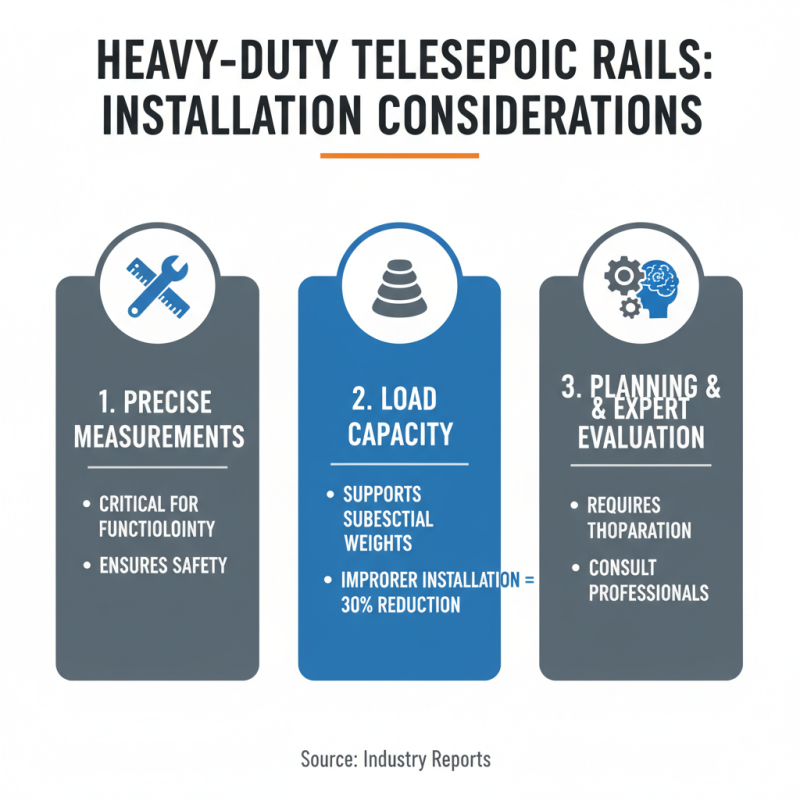
When installing heavy-duty telescopic rails, it’s essential to consider several factors to ensure functionality and safety. Heavy-duty rails typically bear substantial loads; thus, their installation requires precise measurements. Industry reports indicate that improper installation can reduce the load capacity by up to 30%. This calls for thorough planning and expert evaluation.
First, assess the mounting surface's strength. The surface needs to support the rail and the load it will carry. Engineers recommend using 3/8-inch mounting bolts for optimal strength. Retrofitting old structures may require additional reinforcements. Consult structural experts for an accurate evaluation. Additionally, the environment plays a role. Moisture, temperature fluctuations, and potential corrosive elements can affect rail performance.
Beyond physical conditions, user experience matters. Reviews show that many installations face challenges due to inadequate space management. The rail mechanism must allow for smooth operation without obstructions. Test the mechanism after installation to identify any sticking points. Regular maintenance checks can prolong service life. Not following these guidelines may result in frequent malfunctions and unsafe conditions.